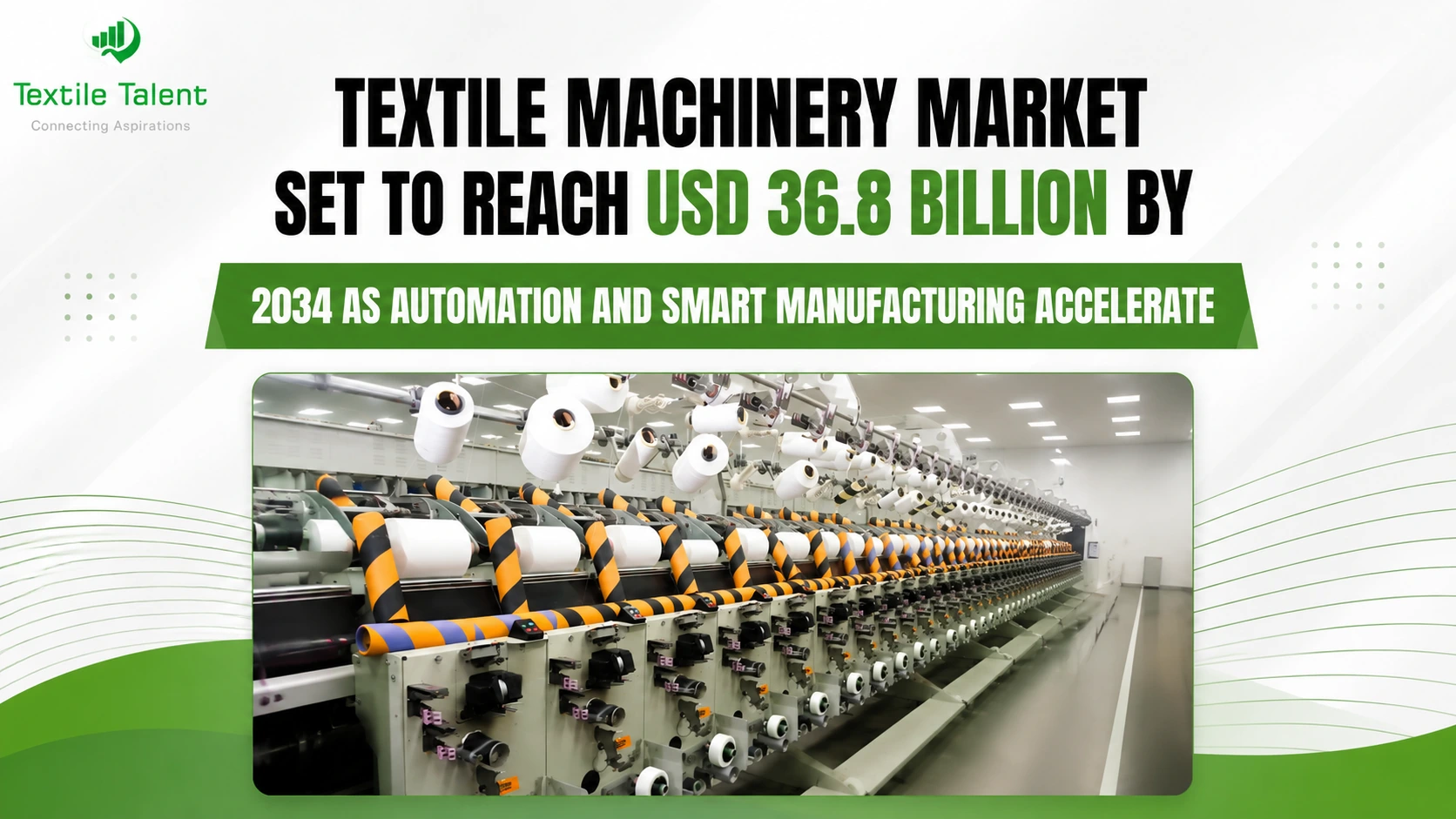

The worldwide demand for textile machinery is undergoing an evolutionary phase of growth driven by new automation, digital manufacturing, sustainability initiatives, and the rise in the use of technical textiles. Previously viewed as a mature industrial sector, textile machinery has now emerged as one of the fastest-growing manufacturing industries, driven by the Industry 4.0 technology revolution and increased capital investment in modernizing manufacturing assets.
According to industry calculations, the worldwide Textile Machinery Market had a valuation of USD 22.4 billion in 2025 and is expected to reach about USD 36.8 billion in the year 2034 with a CAGR of 5.7%, 36.8 billion USD during the forecast period.
This growth indicates much more than higher equipment sales-it symbolizes a significant transition happening in the industry toward Smart Manufacturing systems, sustainable, energy-saving production, and a fully digital textile plant.
Global Textile Machinery Market Overview
Textile machinery is the foundation of textile manufacturing today. These machines are involved in spinning, weaving, knitting, processing, dyeing, printing, finishing, and fabric processing. With an increase in wages and stringent requirements for sustainability, producers are replacing traditional machines with the latest ones.
The shift to smart factories has spurred increased investments not only in emerging countries but also in high-income economies, placing the machinery producers for the textile business at the core of the revolution.
Key Market Highlights
- Size (2025): USD 22.4 billion
- Expected Market Value (2034): USD 36.8 Billion
- Forecast CAGR (2026-2034): 5.7%
- Fastest Growing Region: Asia-Pacific
- Largest Equipment Segment: Spinning Machinery
Major Growth Drivers:
- Factory automation
- Technical textile production
- Sustainable manufacturing
- Smart textile factories
- Industry 4.0 integration
Why the Textile Machinery Market Is Growing
Various long-term industrial trends are changing the focus of investments in textile production.
1. Automation Is Transforming Textile Production
Current textile mills are introducing automation as a way to increase efficiency and reduce human error. Automated production systems provide:
- Higher production speeds
- Lower operating costs
- Better product consistency
- Reduced human error
- Real-time production monitoring
Manufacturers are adopting manufacturing robotics, machine vision platforms, programmable logic controllers (PLCs), and IIoT platforms to streamline manufacturing.
Automation is increasingly desirable in countries with increasing labor costs, such as China, India, Vietnam, Bangladesh, and Turkey.
2. Smart Manufacturing Is Becoming the Industry Standard
Technologies used in Industry 4.0 have been a game-changer in some textile manufacturing processes.
Today’s advanced textile machinery includes features such as:
- AI-powered quality inspection
- Predictive maintenance
- Cloud-based production monitoring
- Digital twins
- Automated process optimization
- Energy consumption tracking
This allows manufacturers to maximize uptime and production efficiency.
3. Demand for Technical Textiles Continues to Rise
Technical textiles, which are an emerging sector, have significantly fueled the growth of the global Textile Machinery Market.
Technical textiles are designed for performance. Processing of technical textiles is significantly different from traditional apparel fabrics.
Major application areas include:
- Automotive interiors
- Medical textiles
- Protective clothing
- Geotextiles
- Aerospace composites
- Industrial filtration
- Construction materials
- Agricultural textiles
These materials can only be produced on accurate, high-performance machinery to ensure quality and technical specifications are met.
Latest Innovations in Textile Machinery
Technological innovations are happening fast due to the overall rising industry.
High-Speed Air-Jet Spinning
Air-jet spinning has proven to be one of the fastest-expanding products in the world of yarn manufacturing.
Compared to traditional ring spinning, air-jet systems offer:
- Much higher production speeds
- Lower energy consumption
- Reduced maintenance requirements
- Consistent yarn quality
- Improved manufacturing efficiency
While ring spinning continues to be used frequently in general because of its unlimited capabilities, manufacturers tend to consistently focus on the advancements of air-jet and compact spinning to enhance productivity.
Compact and Siro-Compact Spinning
There has been a growing market for compact spinning technologies, due to their production of:
- Stronger yarn
- Lower hairiness
- Better fabric appearance
- Higher tensile strength
- Improved spinning efficiency
Specifically advantageous for high-quality garments and technical textiles.
Digital Weaving and Knitting Machines
Advanced weaving equipment now incorporates:
- Computer-controlled pattern generation
- Real-time quality monitoring
- Automatic yarn break detection
- Intelligent production scheduling
- AI-based defect identification
Combined with these features, they make labor activity and material handling more efficient and flexible, and minimize waste.
Sustainable Dyeing and Finishing Equipment
Environmental regulations have pushed manufacturers of machinery to make dyeing and finishing equipment more ecologically efficient.
Modern systems offer:
- Reduced water consumption
- Lower chemical usage
- Energy-efficient heating
- Wastewater recycling compatibility
- Lower carbon emissions
Sustainable practices are already a source of competitive advantage rather than just compliance.
Regional Analysis of the Textile Machinery Market
Asia-Pacific Leads Global Growth
Asia-Pacific has been the largest and fastest-growing region for the world Textile Machinery Market.
The region is expected to grow at a CAGR of around 6.3% till 2034.
- Rapid industrialization
- Growing textile exports
- Government manufacturing incentives
- Capacity expansion
- Automation upgrades
- Rising technical textile production
Despite this, China, India, Bangladesh, Vietnam, and Indonesia still command significant investment in textile production capabilities.
However, India in particular benefits from favorable government policies, a growing domestic manufacturing base, and a large skilled workforce.
Europe Focuses on High-Value Engineering
Europe, representing over one-fifth of the world market revenue, is a continuing center of textile machinery innovation.
Rather than competing on manufacturing volume, European companies specialize in:
- High-precision engineering
- Smart manufacturing systems
- Sustainable production technologies
- Digital automation
- Technical textile equipment
Machine tools demand remains robust in automotive, healthcare, aerospace, and general textile end-uses.
Latin America Gains Momentum
Latin America continues to grow in its textile manufacturing endeavors.
Brazil and Mexico keep setting up state-of-the-art textile manufacturing plants. They are supported by:
- Domestic manufacturing growth
- Nearshoring opportunities
- Rising apparel exports
- Regional supply chain diversification
As a result, these trends are driving the demand for higher specifications of spinning, weaving, and finishing machinery.
Middle East and Africa Show Strong Potential
The growth of industrial parks and textile manufacturing clusters is expanding the markets throughout the Middle East and Africa.
Growth is supported by:
- Digital factory development
- Government industrial policies
- Export-oriented manufacturing
- Infrastructure investments
- Expansion of textile processing facilities
Regions like Turkey, Egypt, and Ethiopia are gaining strength as manufacturing centers, among others.
Spinning Machinery Remains the Largest Product Segment
In all categories of equipment, spinning machines still control the market of Textile Machinery.
Growing demand stems from:
- Expansion of yarn production
- Capacity additions in emerging economies
- Modernization of existing mills
- Adoption of compact spinning technology
- Increasing exports of premium yarn
The producers are still putting huge resources into developing new spinning techniques for both increasing production and enhancing yarn quality.
Sustainability Is Reshaping Equipment Design
The environment has become one of the industry’s most powerful drivers for innovation.
Machinery manufacturers are developing equipment that helps textile producers achieve:
- Lower water consumption
- Reduced electricity usage
- Minimal chemical waste
- Lower greenhouse gas emissions
- Greater recycling compatibility
Evanescent consumer interest in earth-friendly fabrics boosts the wind in new green manufacturing process technologies.
Emerging Opportunities for Manufacturers
It is anticipated that the Textiles Machinery Market will be driven by a number of high-growth opportunities.
AI-Powered Manufacturing
Production planning, predictive maintenance, and automated quality control are coming on leaps and bounds thanks to artificial intelligence.
Smart Factories
The use of centralised textile plants is becoming more prevalent as they allow continual condition monitoring and support decision-making based on data.
Technical Textile Expansion
The increasing demands of industrial, medical, automotive, and defense textiles are generating new equipment needs.
Retrofitting Existing Mills
Rather than develop new plants, many companies are upgrading existing manufacturing sites with automated, mechanized systems to cut capital investment costs and enhance productivity.
Circular Textile Manufacturing
Tools for recycled fibers and biodegradable materials are predicted to be a main growth area.
Challenges Facing the Textile Machinery Industry
Despite positive growth prospects, the market faces several challenges:
- High initial capital investment
- Supply chain disruptions
- Skilled labor shortages
- Rising raw material prices
- Increasing global competition
- Rapid technology obsolescence
Those manufacturers who stay innovative and low-priced will be the long-term winners.
Competitive Landscape
The worldwide market for Textile Machinery is and will remain a highly competitive one. Players invest in becoming more competitive in automation and digitalization.
Leading manufacturers compete through:
- Product innovation
- Strategic partnerships
- Research and development
- Global distribution networks
- Smart manufacturing solutions
- Customer support and after-sales services
The surge in demand for connected manufacturing systems is predicted to increase competition over the forecast period.
Future Outlook
However, the future also lies in smarter & intelligent machinery which is capable of delivering higher performance & efficiency, smart and environment-friendly solutions, low energy and water consumption, support for a high degree of customization, and more automated, flexible production.
By 2034, textile manufacturing machines and factories will be reliably and increasingly outsourced and digitalized. Combined with improved production efficiencies, the total reduction in environmental consumption through combining progress in AI, robotics, Industrial IoT, and advanced engineering principles will result in a revolution in textile manufacturing worldwide.
With the rising adoption of technical textiles, sustainable and eco-friendly production technology, and smart factories, the traditional Textile Machinery Market is set for continuous growth over the next few decades. The players embracing digital technology, energy saving, and flexible manufacturing will win in the megatrend.