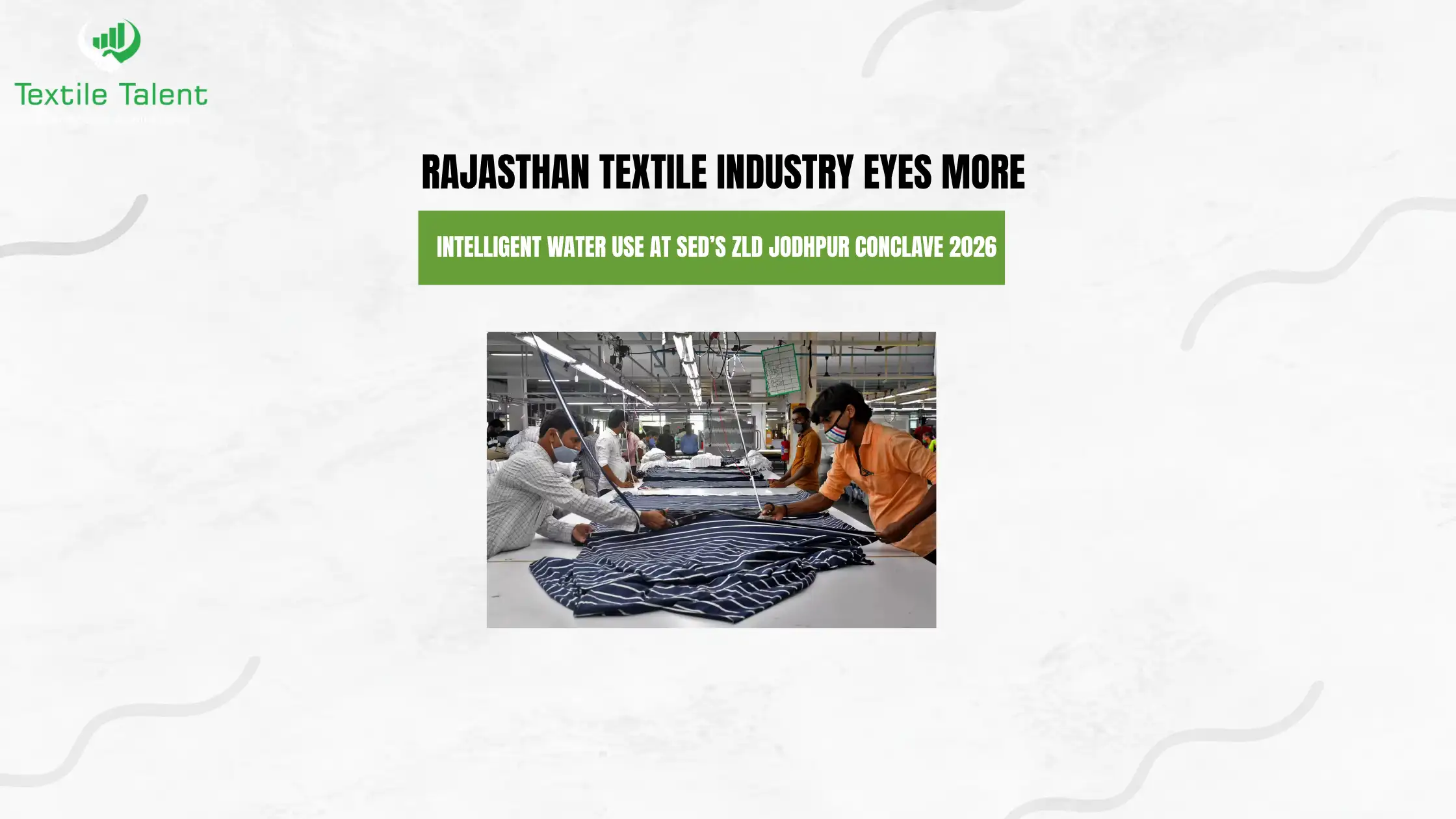
The textile sector in Rajasthan is moving towards a time when ecological care and industrial competitiveness will be linked more and more. Due to increased demand for water, higher environmental standards, and increasing costs of operation, producers are seeking further benefits from wastewater treatment technology.
Amidst the dynamic changes happening across the industrial sphere, a conclave titled SED ZLD Jodhpur Conclave 2026 was hosted to gather the top textile producers, engineers, environmentalists, industry consultants, and representatives from other manufacturing plants. Such a gathering explained the role of modern ZLD technologies in enhancing water recovery, minimizing resource consumption, and boosting sustainable operational efficiencies.
Water Management Becomes a Strategic Priority
From the perspective of textile producers in Rajasthan, water availability and treatment of wastewater will become increasingly important issues to address in their business. Textile processing mills produce a large amount of wastewater and can benefit from making use of water recycling.
The Jodhpur conclave demonstrated how ZLD is transitioning from a regulatory requirement to a strategic investment. Industries are now also considering energy use, operating costs, maintenance, water recovery, and return on investment while assessing wastewater treatment systems.
The interactions at the show reflected this wider trend. Equipment manufacturers are looking for appliances that they can fit into the plants of today and expect to perform dependably for decades.
Industry Leaders Focus on Practical Challenges
A major strength of the conclave was its practical and interactive character. Instead of constraining the presentation of technology, the participants posed questions about operational difficulties encountered with ZLD systems and their integration.
Discussions covered maintenance schedules, cleaning specifications, plant retrofitting, operating economics, and reuse of recovered water for industrial water needs in steam generation.
From these presentations, it was clear that manufacturers want to know the entire life cycle of the wastewater treatment system. For industries, looking at ZLD as an investment technology choice is only one aspect of the selection criteria. Ease of operation, reliability, scalability, maintenance, and integration with existing infrastructure are also key considerations.
The event also generated a good amount of interest from the steel industry. I did have some inquiries from steel industry representatives about acid recovery and acid concentration technologies, as well as whether there are any solutions forthcoming from SED.
At the same time, a high-level industry representative requested SED leaders to seek assistance from the Rajasthan Government on problems faced by the state manufacturers. After this, the conclave entered into in-depth technical discussions where participants discussed various wastewater problems and possible approaches for implementation.
Vimarsh Verma Highlights LTE Technology
On behalf of the company, Mr. Vimarsh Verma, Director, SED, talked about patented Low Temperature Evaporation (LTE) technology, which was one of the major technical highlights of the event.
The invention has been developed with a focus on increasing the efficiency of industrial evaporation processes in support of Zero Liquid Discharge. The invention aims to lower the temperature of the process and, via Mechanical Vapor Recompression (MVR), will lower the amount of steam needed.
Energy use is also important to ZLD plant design, since it is true that evaporation can be one of the most energy-demanding processes of wastewater treatment. For water-intensive industries like textiles, this provides an incentive to optimize the energy consumption of the system, as it will have an immediate effect on economics.
LTE is seen as a modular solution for process industries seeking to reclaim water, concentrate wastewaters, and achieve ZLD in a cost-effective manner.
Discussing the conceptual approach of the technology, Mr. Vimarsh Verma stated that engineering solutions have to be aimed at the concrete industrial needs.
Technology must address real industrial problems. LTE was designed to help industries reclaim water, reduce energy consumption, and develop manufacturing systems that boost businesses and society.
The presentation sparked discussion and was enthusiastically received. Conversations ranged from the technology to implementation, project experience, operating performance, and the practical role of more advanced evaporation systems in satisfying changing environmental demands.
Engineering and Integration Remain Critical
The conclave also highlighted a key element of ZLD success: it is not only the treatment system but more so the entire system design and integration to the industrial facility that results in success.
Mr. Vimarsh Verma described how SED approached each step of the project: wastewater evaluation, system design, plant integration, commissioning, automation, and lifecycle support.
This high-performance approach is especially applicable to existing textile manufacturing plants, where it may not be feasible to replace available infrastructure totally. In such cases, compatibility with retrofit equipment and engineering applicable to a particular plant may become critical considerations in deciding to install or adopt technologies for wastewater treatment.
MVR-based LTE technology is the thrust of this engineering method, mainly due to its advantages of minimal steam consumption and enhanced economic viability of evaporation.
Sustainability and Competitiveness Are Converging
Mr. Vivek Verma, Managing Director, SED, shared a broader insight into the shifting link between sustainability and industrial competitiveness.
He emphasized that the importance of environmental performance should be growing as a component of longer-term business strategy instead of being a stand-alone compliance requirement. Investment in resource efficiencies, operational improvements and stronger resilience should offer returns.
The levels of engagement at the conclave only served to strengthen the view. Most of the questions from the producers, consultants and industry folks centered on the tangible results such as operating cost, extensibility, maintainability, retrofiability, reliability over a period, etc.
This reflects an increasing demand for wastewater treatment solutions that can show environmental and business benefits.
What the Jodhpur Conclave Signals for Rajasthan
The events at the SED ZLD Jodhpur Conclave 2026 indicate a major change in the approach of Rajasthan's manufacturing sector toward wastewater management.
Specifically for the textile industry, water is not just an environmental issue. It is also a business factor affecting operations, cost, compliance, and business sustainability.
Higher ZLD implementation is a step that can take manufacturers toward sustainable water recovery and safe, responsible wastewater management. The more energy-conservative the technology, the more commercially feasible it is.
Furthermore, this event highlighted the importance of direct communication with the manufacturing industry. Equipment manufacturers are after solutions that work practically on the shop floor (rather than just technologies which “work in theory”). So, talk around maintenance, integration, operating economics, and plant-specific needs continues to be vital.
Looking Ahead
The SED ZLD Jodhpur Conclave 2026 once again brought out a distinct perspective for the industrial sector of Rajasthan, which indicated that wastewater management is gradually shifting from being an industry-specific issue to being a part of the agenda of efficiency, resilience and sustainable expansion.
The challenge for textile manufacturers that are caught between water pressures and rising environmental demands will be to find the optimal balance of compliance, resource recovery, energy efficiency and commercial response.
Intensified interest in innovations like SED’s privately owned LTE system indicates that the sector is effectively investigating how to attain the optimal compromise. While producers continue to assess more intelligent water management options, occasions like the Jodhpur conclave can serve as a vital link between industrial problems and engineering applications.
For Rajasthan’s textile industry, however, the takeaway is becoming clearer: sound water management is not only about satisfying environmental demands-it is increasingly becoming an integral part of developing a more robust and competitive manufacturing future.
Content reference: https://www.indiantextilemagazine.in/rajasthans-textile-industry-looks-beyond-compliance-at-seds-zld-jodhpur-conclave-2026/