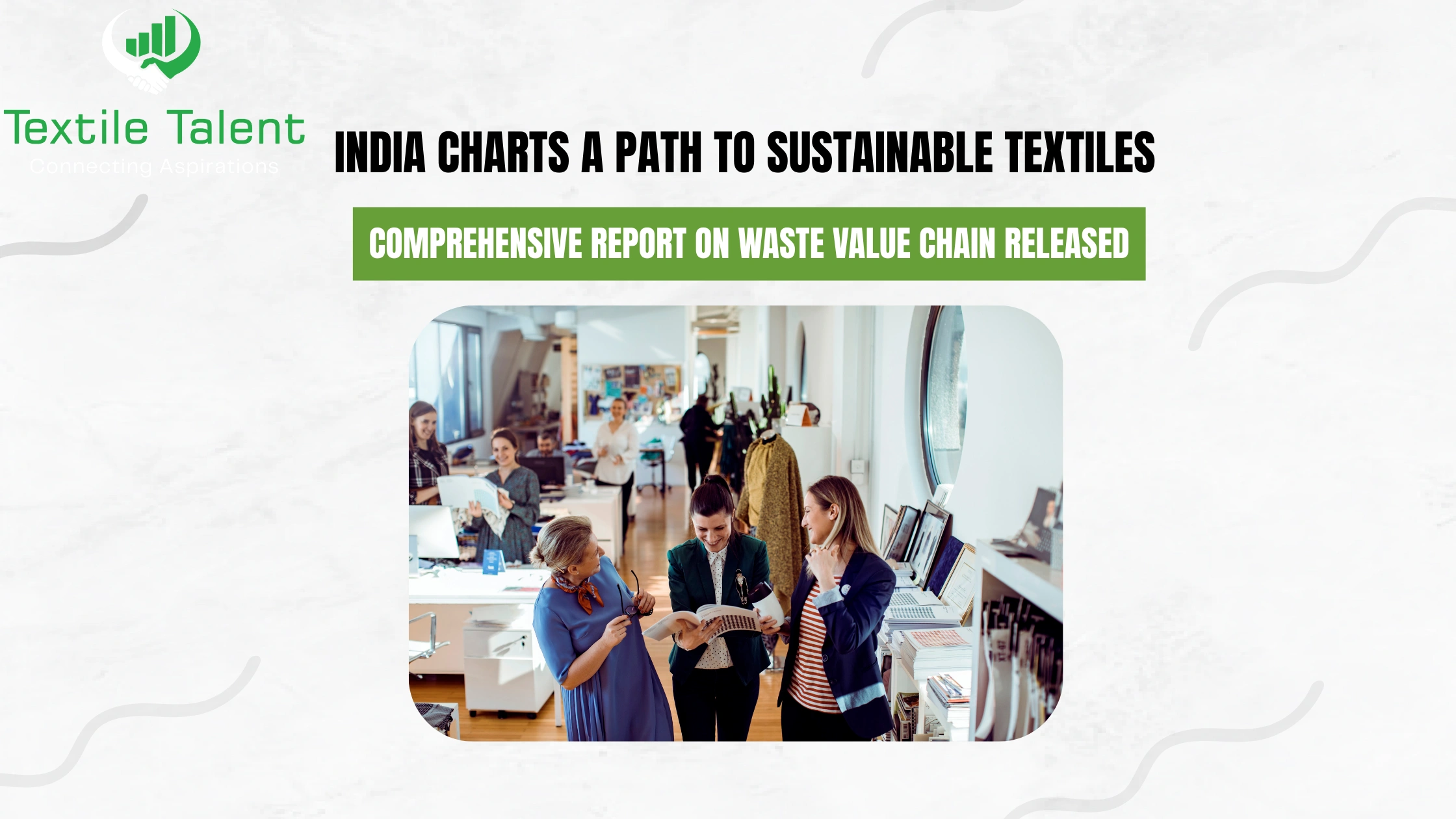

New Delhi, 10 March 2026: The ministry of textiles has published an elaborate report called Mapping of Textile Waste Value Chain in India, in a major move towards facilitating sustainability in the Indian textile industry. The report, which was released by the Union Minister of Textiles, Shri Giriraj Singh at Udyog Bhawan, gives a detailed study of how waste of textile is generated, collected, and recycled in the country. It also provides the plans to develop the textile industry to be a circular economy and make waste one of the resources to be used instead of being an environmental disaster.
This project is timely as the textile industry all over the world is responding to the concerns of sustainability and responsible management of resources. As a notable textile producer of its own, India has a chance and the duty to be the forefront in circular textile production.
Key Findings: Understanding India’s Textile Waste Landscape
The report indicates that India yields about 70.73 lakh tonnes textile waste per year factoring both the pre-consumer and post-consumer sources. Pre-consumer waste which constitutes approximately 42 per cent of total waste is mainly produced as a result of manufacturing offcuts, defective fabrics and production leftovers. Post consumer waste, which makes up approximately 58 percent, is as a result of used garments, home fabrics and other consumer products.
Another significant observation in the report is that recycling, upcycling and downcycling or reuse of textile waste recover more than 70 percent of the total textile waste. The most remarkable is the recovery rate of pre-consumer waste that is very high at 95 percent and is recovered back into production because of standardized waste streams and the proximity of the waste to manufacturing units. It means that the Indian textile sector has already put a solid platform on circular production.
The importance of this initiative has been emphasized by Shri Giriraj Singh who claimed that the report offers a data-driven plan to convert textile waste into useful economic assets. It does not only facilitate sustainability, but it also fosters recycling and reuse innovations, which assist India in leading the world with circular textile.
Spinning Sector: A Model of Circular Efficiency
The efficiency of the spinning sector in India is one of the best observations in the report. In this case, spin-off waste, or so called soft waste is nearly reabsorbed into the production process. The fact that this reuse is almost 100% in-situ is possible because of the following reasons:
-
Uniform Waste Streams: Waste fibers in spinning are uniform in quality and size, and therefore can be reused instantly.
-
Proximity to Processing Units: The majority of spinning mills treat waste on-site, eliminating transportation and handling.
-
Quality Standards: The rigid industry standards make sure that the quality of recycled fibers is up to the quality standards of the final products.
This closed-loop solution is able to reduce environmental impact to the least but ensures cost efficiency that can be an example to other sectors in the textile industry.
Post-Consumer Waste: Social and Economic Implications
The pre-consumer waste is mostly handled effectively but post-consumer textile waste has its challenges and opportunities. According to the report, approximately 55% of the post-consumer waste is redirected off landfills with a well-developed informal chain of collection, sorting, and redistribution. It sustains the livelihood of about 40-45 lakh individuals, mostly women who are marginalized communities and they collect, sort and sell used textiles.
This type of informal sector serves two purposes; it lowers the environmental pressure and enables local people. Through institutionalizing and legitimizing such networks, India is able to improve the social and economical results wherein the sustainability initiatives applied are both inclusive and just.
Emerging Hubs and Technological Innovations
Panipat, Haryana, is a large hub in mechanical textile recycling and the report receives textile waste at its location where it is processed. The research indicates that increasing recycling facilities within such clusters may enhance the efficiency, lower transportation expenses and make the local circular economies stronger.
Another theme is technological innovation. Although mechanical recycling is the most commonly used method, chemical recycling is on the rising trend. This sophisticated process enables breaking down of the fibers to their molecular constituents, and the textile-to-textile recycling process can retain the quality of the materials and offers a truly cyclical process.
Future Outlook: Economic Potential and Green Jobs
Going forward, the recycling market of the Indian textile is expected to be USD 3.5 billion by 2030 and generate about one lakh new green jobs in the field of recycling, processing, designing, and innovations. The development not only helps India to be more competitive at the global level but also helps in the sustainable growth of the economy.
Implementing the ideas of circularity into the textile industry has several advantages:
-
Environmental Sustainability: Less landfill and less use of virgin materials.
-
Economic Opportunities: Value added production and market development of recycled textiles.
-
Social Empowerment: The empowerment of informal networks and the offer of employment, particularly of women and marginalized communities.
With all these advantages, India stands a good chance of becoming a leader in sustainable textile manufacturing in the world.
Ministry’s Commitment and Way Forward
The Ministry of Textiles reiterated its plans to encourage sustainable production and circular resource consumption. It is anticipated that the report will inform policy making, promote collaboration in the industry, and create an interest in recycling technologies.
Key recommendations include:
-
Expanding cluster-level recycling infrastructure to reduce waste transport and improve efficiency.
-
Encouraging research and development in advanced recycling technologies such as chemical and fiber-to-fiber recycling.
-
Supporting informal networks through training, financial aid, and formal recognition.
-
Promoting awareness among manufacturers and consumers about the economic and environmental benefits of textile recycling.
Shri Giriraj Singh pointed out that sustainability and economic growth could be a combination. He said that with the right strategies, we can make the textile industry in India a global leader in circular and sustainable textiles and open up opportunities to innovate and provide jobs.
Conclusion
Mapping of Textile Waste Value Chain in India report is a milestone towards the textile industry in India. Through offering an in-depth analysis of waste production, waste recovery measures, and the possibilities of recycling, it puts a transparent roadmap on the way to the circular economy.
Spinning mills with almost complete reintegration of waste to informal networks with millions of livelihoods, India has known that it can be both sustainable and economically growing. With improved technologies in recycling and the growth of infrastructure in the industry, India has a potential of becoming a global leader in sustainable textile manufacturing.
With policy support, technological innovation, and increased awareness, the nation is moving toward a future where textile waste becomes a valuable resource, generating green jobs and empowering communities while protecting the environment.
The full report is accessible on the Ministry of Textiles website, providing detailed data, insights, and recommendations for stakeholders across the textile value chain.