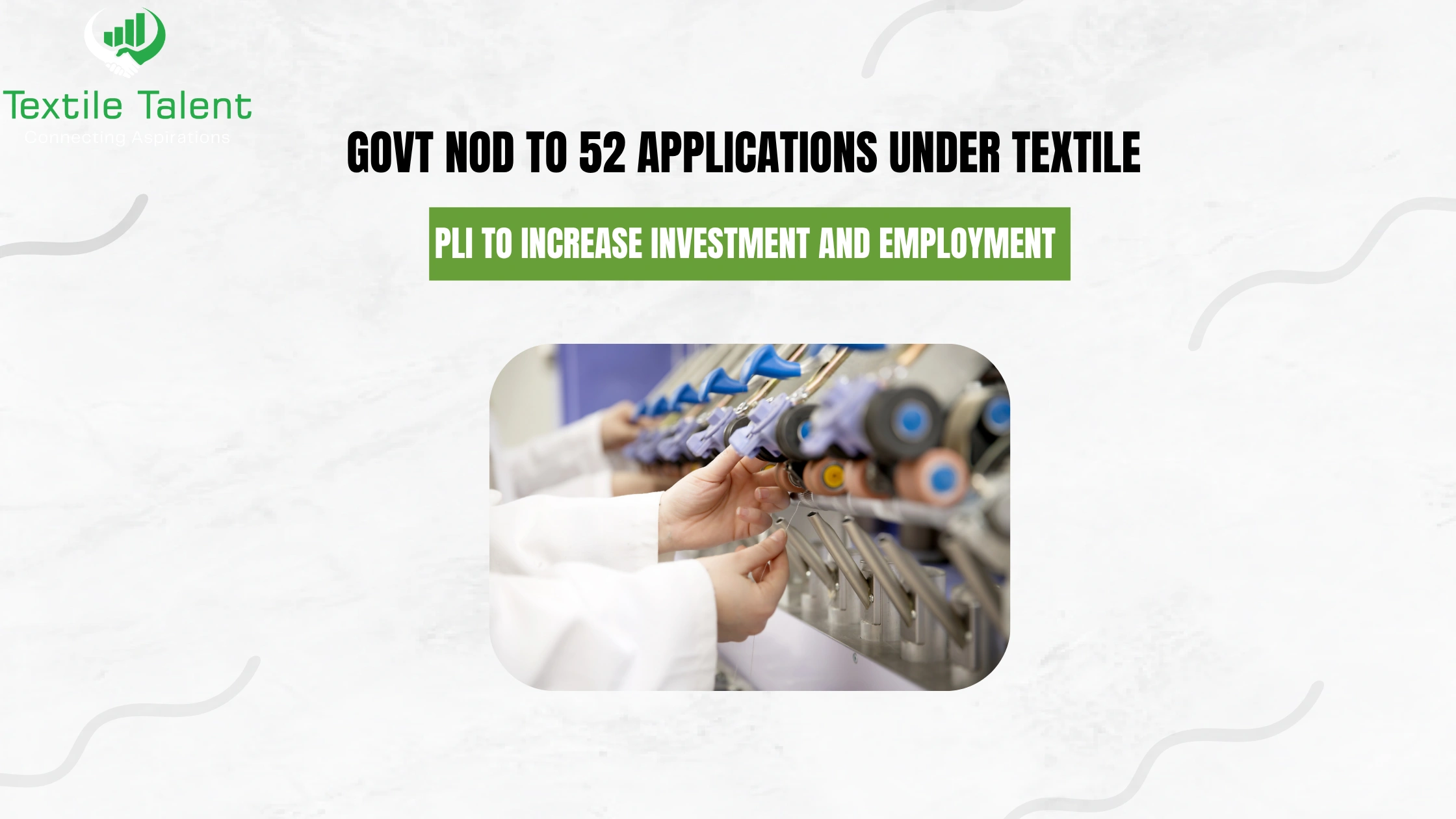

The government has given the green light to 52 applications under the Production Linked Incentive (PLI) scheme on textiles in an important move to the Indian textile industry. This action will help boost the manufacturing power, bring in large investments and improve the status of India in the international textile market.
The approvals belong to the third round of the PLI scheme and indicate the ongoing government interest in developing high-value segments like an apparel of man-made fibre (MMF), MMF fabrics, and technical textiles.
Good Industry involvement and investment pledges
The applications that have been approved are a mixture of the various companies that are involved in different sectors of the textile value chain. Of the total five apps are in MMF apparel, 19 in MMF fabrics, 18 in technical textiles and 10 cut across categories.
The combined investments of these companies are more than ₹6,700 crore. The turnover of these investments is projected to be over 21,000 crore, which means that the scheme has a big confidence and is beneficial in the long-term.
This form of participation underscores the increasing desire of the local and foreign investors in the Indian textile industry.
Target High-Value and Advanced Segments
The PLI program has been planned in such a way that the textile sector of India is to be transformed to be more innovative and high value products. The industry has long been dominated by cotton-based products, but currently it is shifting to MMF and technical textiles, which are more popular in the global markets.
Likewise, the technical textiles are becoming more significant with their usage in sectors, like medical, construction, automobile and military. This change will see India become more competitive in the world and less reliant on imports.
Increasing Finding of Jobs throughout the Industry
The new approvals will significantly affect the employment generation. The growth of new manufacturing facilities, and the addition of more production capacity, will develop thousands of jobs in the textile industry nationwide.
The shortage of talent in factory workers and talented professionals are only likely to grow in various fields. The expansion will not only be on production but also on design, research and development.
Design and Urban Job Markets Growth
The increased activities of textile companies in major cities will result in an increase in the number of creative professionals. Jobs like textile designer jobs in chennai, textile designer jobs in bangalore and textile designer jobs in mumbai are projected to increase tremendously.
These cities already boast of good industrial and design ecosystems, and this growth will only enhance their presence as a source of employment in the textile industry, brought about by the PLI.
Meanwhile, the traditional textile centers will also gain. Areas such as Panipat will experience more job opportunities, such as textile designer job in panipat, as the production will grow.
India, Boost to Textile Jobs
The wider effect of the scheme will be witnessed in the growth of textile jobs in India both in town and country. The new manufacturing plants and supply chains will create jobs in the spinning, weaving, processing, and technical textile manufacturing.
This expansion will contribute to the vision of inclusive economic development of the government as it will provide employment opportunities in small towns and semi-urban localities.
Indicators of early success of the PLI Scheme
The scheme of PLI has already demonstrated good outcomes. Firms that have been involved in the previous stages have stated that their investments have been in the tune of hundreds of crores and their ability to generate high turnover in a brief span.
There is also the start of exports of these units and this implies that it is becoming competitive in the world. These initial successes have motivated additional companies to seek application under the scheme which has resulted in the recent round of approvals.
Support of the policy and Future
The government has also changed the deadline of the scheme to March 2026, which will enable more companies to join. This extension has been very instrumental in bringing more proposals and wider involvement of the industry.
Other projects are also underway to aid in the development of the sector, these include the PLI scheme along with mega textile parks and infrastructural development projects. These will serve to deliver the best in class facilities, lower logistics expenses and enhance simplicity of conducting business.
The increasing Global Competitiveness in India
As the world supply chains are being transformed, India stands in a good position to win more market share of the textile market. Through the PLI scheme, coupled with favorable policies, the country is increasing its manufacturing magnitude and quality levels.
Innovation, technology and high value product focus are likely to lead to long term growth and position India as a location of choice in the production of textiles.
Conclusion
The textile PLI scheme has been an important milestone to the industry with the government approving 52 applications of the scheme. The industry is poised to grow strongly due to its high investment activities, emphasis on high-end markets and the increasing number of job opportunities.
As such projects get underway, they will not only increase production and exports but will also generate a plethora of opportunities within the workforce. The future of the textile industry in India is becoming even more promising, not to mention that the positions that once were manufacturing are now designed.