
What is Yoke in Garments?
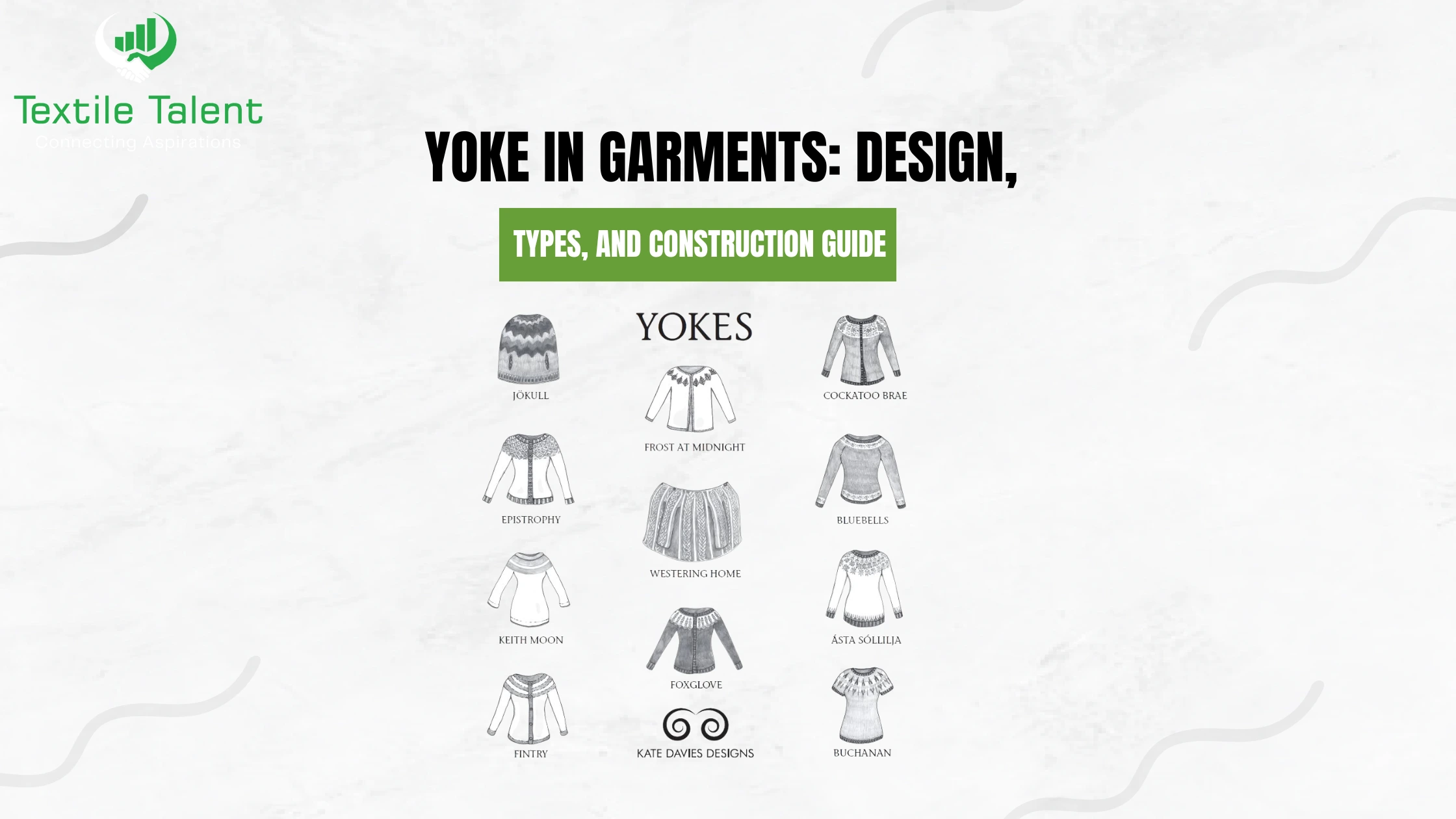
A yoke is a shaped pattern piece that makes up the upper part of a garment, such as around the shoulders, neck or hips. It is attached to the body of the clothing by a horizontal or decorative seam line. The yoke will be on the front bodice in front of the bust and on the back either on, above, or below the shoulder blades. The yoke shapes the gathers, pleats, tucks, or plain fabric hanging beneath.
In reality, then, what does yoke design mean? It means control over the form, dimension, location and treatment of this upper part. Yokes provide shaping to the free areas of the garment body, say a shirt or a gathered skirt, and also consume dart values in order to maintain a sleek upper waste and shoulder line. Today, a yoke can still be used decoratively as well as functionally.
Different Types of Yokes in Garments
Yokes are categorized according to where they sit on the body. They can be divided into three categories: shoulder, midriff and hip yokes.
A shoulder yoke is a horizontal yoke that is inserted across the upper chest or back and is typically found on men's shirts, blouses and frocks; a midriff yoke is placed above the waist at the natural waist line and is mostly found on dresses and kurtas,finally a hip yoke is inserted below the waist and is predominantly found on skirts, trousers and jeans where it is used to absorb the dart value and create a smooth fit through the hip region,
Factors That Decide Yoke Selection
There are multiple reasons to select a particular yoke in a garment.
-
Fabric pattern. If you want to use a printed fabric, the yoke shape need to be consistent with the pattern. Straight line yoke design looks much better on checked and striped fabric with shape of yoke for frumpy style. Reflective floral prints and curved pattern will blend with round/scalloped yoke shape for shapeful style.
-
Garment construction. The yoke should have some connection to other design features such as the collar, cuff and pocket - a slight change in shape makes the garment less stagnant.
-
Function. Plain yokes are popular for school uniforms and house clothes. Various yoke styles, such as asymmetrical and scalloped designs, as well as contrast-trimmed versions with proceeds, are appropriate for partywear.
-
Age of the wearer. Girls' garment yokes tend to be rounded and curved. Boys' and men's tend to be straight. Old people tend to wear more neutral without large appliqué and decoration.
-
Figure of the wearer. A short, stocky figure is flattered by a yoke that is broad and deep, with vertical line. These give the illusion of added height. A slim figure is flattered by a yoke that has horizontal line because they tend to give the illusion width. The shoulder yoke should be broad at the shoulder level and taper towards the waist level.
Creating Variety in Yoke Design
A few ways you can vary your yoke are:
-
Shape and size. They may be square, round, straight, scalloped, triangular, or unbalanced. The depth can be widened or deepened to change shape. Yoke's comprising of panel may carry down into the rest of the garment, or one may have a partial yoke that can carry down or halt partway through the garment.
-
Material and grain. Two different colors or prints can be used for the yoke and the body of the garment. The grain of the yoke may also be cut at a different angle to that of the body fabric.
-
Seam line treatment. The yoke seam can be embellished with ruffles, lace, faggoting, adding decorative stitches or top stitching with contrast thread.
-
Inside the yoke. Beading, quilting embroidery, shirring, smocking, tucks and pleats. All of these decoration can be put inside the yoke.
-
Position on the body. While as discussed above, the yoke can be placed on the shoulder, midriff or hip.
-
Fullness release. Create yoke so gathers, pleats, or tucks release from the seam edge into the body.
Pattern Preparation for Yokes
Yoke patterns fall into two general types: those with fullness and those without.
Yoke Without Fullness
In general, this style includes all the simple yoke shape. The yoke line should be drawn from shoulder to the bodice pattern center front for a curved or V shape yoke. No V shape yoke is a straight line which is also from armhole to bodice pattern center front. Both parts are named and cut.
Yoke with fullness
These yokes are split with tucks, pleats, gathers, shirring, or embroidery below the yoke. The body fabric is given the fullness first. The aspect fabric is cut in the width as required and tucks or pleats are stitched as per design. The yoke pattern is then cut on the sewn fabric with allowance.
Attaching the Yoke
A plain seam or a lapped seam are both suitable to join the yoke to its lower section. The gathered width of the skirt needs to be equal to the yoke width. The yoke is to be placed over the skirt right sides together with, notches matched, with gathers evenly distributed with pinning and tacking. The yoke is to be stitched, the tacking removed, the yoke turned up and pressed.
In the case of a yoke where there is a mixture of curved and straight lines (e.g. A skirt yoke with a panel), the seam in the corner will be nearly perpendicular. The lower part is stitched by gathering and stitching in place first. Then the yoke is stitched so that the seam is very close to the edge with the corners reinforcing. The seam allowance is then turned under and tacked very close to the fold, and the notches are clipped into the seam allowance to help the seam lie flat.
Finally, the yoke is set on top of the lower section with seams aligning and an edge topstitched near the edge of the fold line. This can be achieved by stitching just in from the fold.
Yokes on Shirts, Trousers, and Coats
Yokes on shirts, tops and coats can be cut in two different ways. These are cut as follows; The yoke is cut as one pattern piece, with the front yoke and back yoke joined on shoulder line, or separate front and back yokes can be cut, the 2 nd method is used with drop shoulders where it is necessary to follow the shoulder curve, the only time a single piece yoke is used with darts at the shoulder to allow the curve.
On trousers and skirts, the hip yoke is a good alternative as it takes the dart value into one seam hence having no darts showing on the front or back.
Importance of Yoke in Garment Construction
The yoke has multiple functions in the making of a garment.
It supports the looser parts of the garment e.g a gathered skirt or the body of a shirt. It spreads the weight of the fabric over the shoulder or waist area. It gives a good fit as it molds to the natural shape of the body, e.g across the shoulders or hips. It gives good range of movement as it does not restrict shoulder and back movement. It causes the shoulder seam to move off the shoulder top which eliminates chafing under bag straps.
The yoke is mostly a design surface. Often you will find decorative stitching, embroidery, contrast fabric and trim in this area as it is very eye level and visible.
Conclusion
The yoke is one of the more useful construction elements in garment making. It carries weight, controls fullness, absorbs dart values, and gives the designer a clear area to add detail. Understanding what is yoke design and the different types of yokes available helps in selecting the right one for a given garment, fabric, and wearer. From plain shoulder yokes on school uniforms to decorative hip yokes on western skirts, the yoke continues to be a fixture in both functional and fashion-led garment design.
Read Also: Types of Fleece Fabric Explained
Our Latest Textile Jobs